
Rubeau
Testers

The office, rearranged. Your AI staff at work, right in front of you.

  • Windows
  • in development
  • no public release yet
  • built on Claude
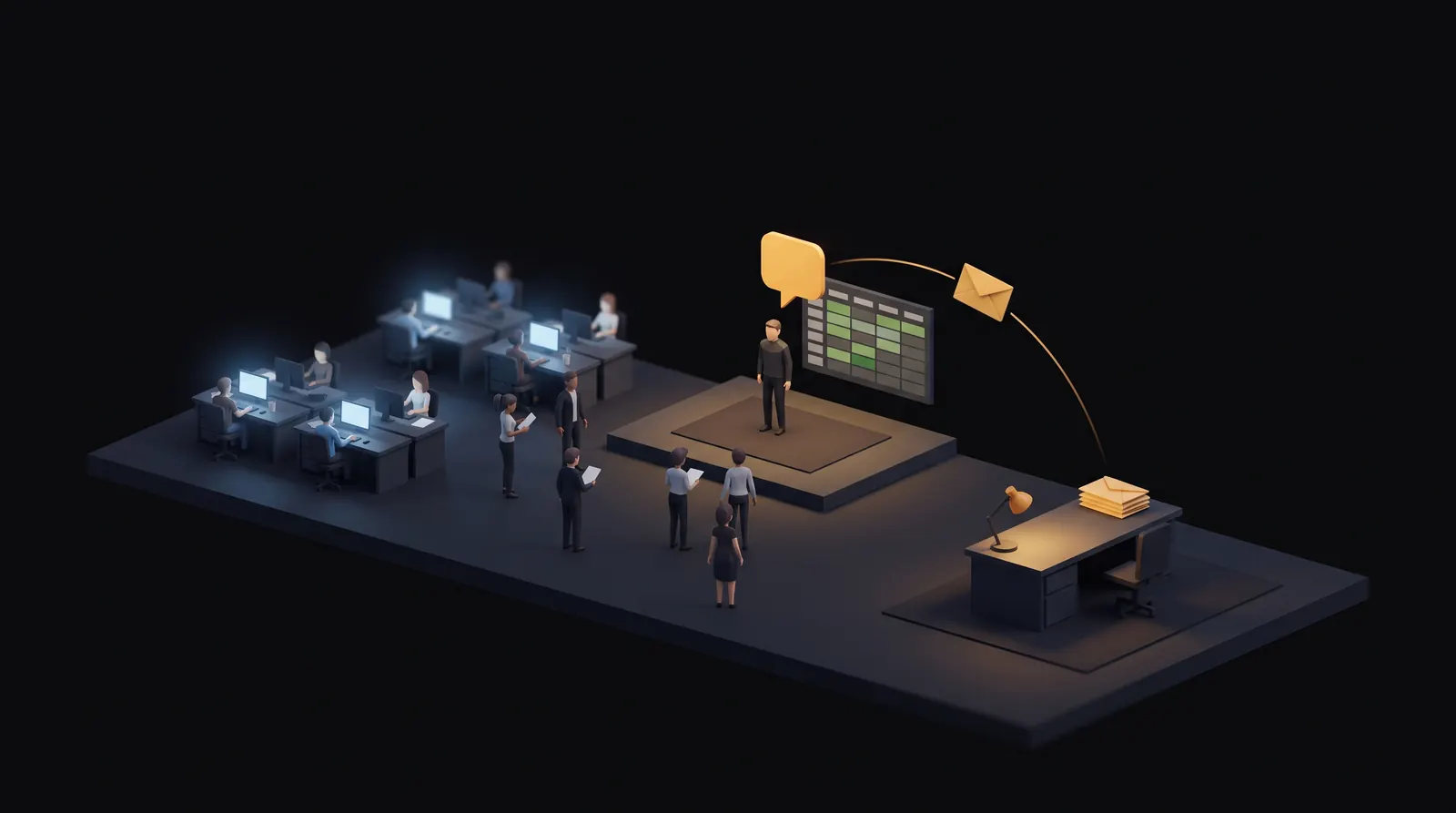
Illustration: an office seen from above, at night. Staff at their desks in front of blue screens, a platform with a mission board, and in the foreground the CEO's desk lit by an amber lamp.
Illustration — not an app screenshot

The brief

A company of AI agents you run without writing code: describe what you want, a chief takes the mission, gathers colleagues, delegates, and you get the result — knowing who did the work, who is stuck, and what it used.

Not a graph of agents. A company you watch at work.

Every agent is a permanent employee with a name, a face, seniority, a mission history and a running total of usage. You see the same faces every time you open the app. Your agents are not disposable: they have careers.

Walkthrough

The floor lights up

An office that is always there, seen from above. Nothing that moves on screen is decoration: it shows what is really happening in the company.

Skip the walkthrough
Illustration: the office floor seen from above, revealed zone by zone — the desks, the blue screens, the platform with the mission board, and the CEO's desk under its lamp.
Illustration — the real app view is further down
  1. An office that is always there

    The same rooms and the same people every time you open it. The company keeps its staff from one mission to the next.

  2. A finite number of desks

    Every room has its capacity, and you can see it on screen. When work changes hands, people change desks.

  3. Work in progress

    A lit screen means someone is on a mission right now.

  4. One chief per mission

    The chief splits the work, hands each part to a colleague and returns the summary. The mission board is on the wall.

  5. You, at the centre

    The CEO's desk. When a decision is yours to make, a letter lands here.

Zone 5 of 5

Between missions

  • A coffee break, a game of ping-pong: these show people who are genuinely idle, never a random animation. Ping-pong takes two idle people in the same room.
  • The company can have working hours. If you set them, everyone goes home at night and the floor empties: no new mission starts, unless you override the hours.
  • Closing is not killing: a mission in progress runs to the end, even after hours.

OpenClosed — everyone has gone home

No hours are imposed by default: it's your company, so set them if you wish.

Letter no. 1

Mission received

You say what you want. The chief reads the mission, breaks it down and hands each part to a colleague. Desks are limited: when a room is full, the colleague sits in the open space, and the journal says so. When a decision is yours to make, a letter heads for your desk.

Skip the demo
Demo mission

Scripted demo — nothing actually runs, no network calls

  1. Read
  2. Delegate
  3. Overflow
  4. Write to the CEO

Step 4 of 4 One decision is yours alone: the chief writes to you, and the mission pauses without consuming anything.

How the work is split between employees
EmployeeRoleWork assigned
Inès MarchalChiefDirectorOutline and summary of the comparison
Théo GarnierResearcherPublic pricing of the 3 CRMs
Maëlle RouxLegal counselData hosting and GDPR

Desks taken 3/3

Cancellation termsin the open space, outside their department — room full

  1. Inès Marchalmission started "Prepare a comparison of 3 CRMs for a small business"
  2. Inès Marchaltakes the desk
  3. Inès Marchalwork plan 3 steps
  4. Inès Marchalhands off the work to Théo Garnier: public pricing
  5. Théo Garnierjoins the mission
  6. Inès Marchalhands off the work to Maëlle Roux: data and GDPR
  7. Théo Garnieruses a tool web search
  8. Théo Garnieris done
  9. Inès Marchalasks you for a decision
  10. Missionwaiting for your reply

Letter delivered to the CEO's desk

Inès Marchal is calling you

Two of the three CRMs don't publish their prices: do I compare them on their public plans, or widen to CRMs that publish everything?

Fictional names. Event labels are translated from the app's journal, which is in French today; the demo itself is scripted.

Open the letter

A decision is yours to make

A chief is instructed not to ask your permission to work. They write only when the decision is truly yours: two incompatible directions, a scope so ambiguous that guessing would waste the budget, a finding that contradicts the mission, or a choice that is hard to undo.

Nothing is delivered before the CEO sees it.

Inès Marchal is calling you

From
Inès Marchal, Director — mission chief
To
The CEO
Subject
Mission "comparison of 3 CRMs for a small business"
Used so far (API equiv.)
$0.37 (sample value)
Deadline
she decides on her own in 9 min

Two of the three CRMs don't publish their prices for ten users. Do I compare all three on their public plans, or widen to CRMs that publish everything?

Why I can't decide on my own Either choice changes the deliverable, and guessing what you want would waste the budget.

In the app, a decision letter comes with a free-text reply field; folder and delivery requests are answered with buttons only. Nothing is sent from here: this page calls no model.

See who did the work

And if nobody replies?

No reply from you — the deadline has passed

The chief decides alone, taking the most cautious, most reversible option, and her final reply states which question went unanswered and what she assumed.

The rules of a letter

  1. One question, written for someone who hasn't followed the work.
  2. Up to 4 genuinely different replies: you answer in one click.
  3. At most 3 calls to the CEO per mission: beyond that, the chief decides alone and says so.
  4. While it waits, the mission is paused and consumes nothing.
  5. No reply within 10 minutes? The chief decides alone and writes down what they assumed.

In the app, a chief can also read their call aloud, in a voice synthesised on your machine, offline.

Sample letter — mock-up. Its rules, buttons and deadline come from the app, translated from French; the header layout, names and amount are fictional.

Letter no. 2

The file decides

The personnel file decides who gets the work — not chance, not whoever arrived last.

The AI model belongs to the person and is chosen at hiring: the same company employs different profiles side by side.

You hire, you review, you make the call. The product informs; it never forbids.

  • Chief

    Inès Marchal

    Role
    Director
    Model (chosen at hiring)
    top tier
    Verdict
    reliable
    Seniority
    18 days
    Missions
    14 missions
    Failure rate
    8% failure
    Tool calls
    96 tool calls
    Total used (API equiv.)
    $11.20
    Per mission
    $0.80/mission

    13 missions concluded, 8% failure, $0.80 per mission (averaged over 14 missions).

  • Théo Garnier

    Role
    Researcher
    Model (chosen at hiring)
    economy
    Verdict
    improving
    Seniority
    18 days
    Missions
    22 missions
    Failure rate
    18% failure
    Tool calls
    171 tool calls
    Total used (API equiv.)
    $2.64
    Per mission
    $0.12/mission
    Trend
    trend: 36% → 0% failure

    improving: 36% failure before, 0% since.

  • Maëlle Roux

    Role
    Legal counsel
    Model (chosen at hiring)
    mid tier
    Verdict
    unproven
    Seniority
    3 days
    Missions
    2 missions
    Failure rate
    0% failure over 2
    Tool calls
    14 tool calls
    Total used (API equiv.)
    $0.96
    Per mission
    $0.48/mission

    2 missions concluded — too few to judge (3 are needed).

Illustration — not an app screenshot 

A file's verdicts

unproven
not enough concluded missions to judge
reliable
delivers, rarely fails, and costs little per mission
improving
fails markedly less than before
expensive
delivers, but costs a lot per mission
uneven
delivers, but fails too often to be called reliable
declining
fails markedly more than before
failing
fails half the time or more

A mission you stop is not the fault of whoever led it: it counts as neither a success nor a failure.

Fictional sample data — the fields and verdicts are the app's, translated from French.

Letter no. 3

Nothing leaves without you

Three clauses, enforced by the code, not just promised.

  1. The team writes only in the folder you grant it

    When a chief needs to write files, they ask you in a letter. You choose the folder yourself, or let them carry on without writing.

    I need a folder to write files in. Will you grant me one?

    • Choose a folder…
    • Carry on without writing

    the app's buttons, not clickable here

    No reply, no folder: a right is never won by waiting.

  2. Budgets are capped

    Every mission has its own budget, set at launch. The company also has a monthly cap: once it is reached, no mission can start.

    $0.37

    Used $0.37Stops above $2.00

    illustrative values, in API-equivalent dollars, as in the app

    The budget is checked between work turns: a turn already under way runs to completion, so the total can go over the budget.

  3. Nothing is delivered before you have seen it

    When the work is done, the chief shows you what was written to your folder — file names and sizes — and asks whether to hand it over. What the chief says and what Rubeau has checked are shown separately.

    The work is done. Here is what was written to your folder — shall I hand it over?

    What the chief says — their words, unverified:

    The comparison is ready, with an appendix on pricing.

    What Rubeau has checked:

    • crm-comparison.md — 6 KB
    • pricing-appendix.md — 3 KB

    sample files

    CEO's trayThe document is waiting for your decision.

    No reply means the work is not handed over.

What is true today

  • In development
  • No public release yet
  • Windows app
  • 2,000+ automated tests
  • Built on Claude
  • Runs locally, on your own subscription or key
  • Funded by the founder so far

Mock-up: the letters' questions and buttons are the app's own, translated from French; the amounts (API equivalent — on a subscription, not a bill) and the files are examples.

The journal

Everything is an event in the journal

The same source feeds the building on screen, the personnel files and the usage.

Nothing is decorative: every movement on screen is the rendering of a piece of data.

  1. Time Who Inès MarchalEvent mission startedDetail comparison of 3 CRMsFeeds: Building · Files
  2. Time Who Inès MarchalEvent takes the deskFeeds: Building · Files
  3. Time Who Inès MarchalEvent work planDetail 3 stepsFeeds: Building
  4. Time Who Inès MarchalEvent hands off the workDetail to Théo GarnierFeeds: Building
  5. Time Who Théo GarnierEvent takes the deskDetail Open spaceFeeds: Building · Files
  6. Time Who Théo GarnierEvent uses a toolDetail web searchFeeds: Files
  7. Time Who Théo GarnierEvent usageDetail $0.04Feeds: Files · Usage
  8. Time Who Théo GarnierEvent is doneDetail report returnedFeeds: Building · Files
  9. Time Who Inès MarchalEvent asks you for a decisionDetail one question, 3 repliesFeeds: Building
  10. Time Who CEOEvent you repliedDetail reply no. 2Feeds: Building
  11. Time Who MissionEvent resumesDetail after waiting 1 min 32 sFeeds: Building
  12. Time Who Inès MarchalEvent mission finishedDetail $0.91 in totalFeeds: Building · Files · Usage
  • Building10movements on screen
  • Files7personnel-file entries
  • Usage2usage lines

The journal is append-only: nothing is erased, nothing is rewritten.

Lines reconstructed for this page: the event labels (translated from French) and the time format are those of the app's journal; names and amounts are fictional. Amounts are in API-equivalent dollars, as in the app: on a subscription, this is not a bill.

Today

Where Rubeau stands

Project status

2,000+ automated tests

  • In development
  • No public release yet
  • Windows app
  • Built on Claude
  • Runs locally, on your own subscription or key
  • Demo on request
Current milestone
Taking a project all the way through to the deliverable: started on 14 September 2026, not yet finished.

Timeline

  1. First commit: a multi-agent engine with no interface, under a code name.

  2. The office on screen, and a first real mission launched from the app.

  3. The company takes shape: the personnel file decides who works, the office has working hours, and the chief writes to the CEO.

  4. The isometric city, the chiefs' voices, and a new name: Steading.

  5. The building takes shape in 3D, and people sit down at their desks.

  6. The building gets its glass lobby, and people walk in 3D instead of teleporting.

  7. Core decisions: the team writes only in the folder you grant, on your own subscription or key. And the delivery letter: nothing is handed over until the CEO has seen it.

  8. More than 2,000 automated tests, and Steading becomes Rubeau.

The only letter on this page that is not a mock-up

A note from the founder

I'm Javad Razavi, and I have been building Rubeau on my own since June 2026.

I wanted to run AI agents like a team you know well: the same faces, a personnel file, a cost, and a letter when a decision is mine to make.

What exists today: a Windows app that runs real missions on Claude, a company that keeps its staff, a journal where everything is written down, and more than 2,000 automated tests.

What doesn't exist yet: a public release. The next milestone — taking a project all the way through to the deliverable — has started, but isn't finished yet.

The scenes on this page are illustrations, and each one says so: I would rather show honest work in progress than a product built on promises.

If you want to try it, challenge it or simply talk about it, write to me. I read and answer every message myself.

Javad RazaviFounder of Rubeau

For investors

Rubeau is for people who don't write code but have work to hand over. Once an app runs a whole company of agents, the real question becomes: who do I keep, who costs too much, who keeps failing? A developer can read logs to find out; everyone else can't. Rubeau answers that question with a measured personnel file, finite capacity and a letter to the CEO.

Today, the app runs on Windows, carries out real missions on Claude and rests on more than 2,000 automated tests. There is no public release yet, and the project is funded by its founder.

I'd like to talk with people interested in joining or backing the project. The address is the same for everyone: a first conversation is simply a chance to get to know each other and look at the product together.

Write to Javad

You are…

You'll get a message when a test build is ready. For now, it's Windows only.

Tell me what you'd like to hand over to a team: that's what helps me most.

The subject line of your email will be pre-filled based on this choice.

The real thing

Real screenshots from the app

This strip shows only images captured from the app itself. No illustration slips in. The work scenes are an on-screen replay of a real past mission.

One mission, start to finish

A replay of a real mission, sped up: the request, the chief taking it on, the delegation, then the report back to the CEO. No sound.

  • The cityIsometric view — app screenshot
  • The 3D view3D view — app screenshot
  • A letter to the CEOLetter to the CEO — app screenshot
  • A personnel filePersonnel file — app screenshot
  • The journalMission journal — app screenshot
App screenshot: the company seen from above in isometric view, with its rooms, desks and employees, during the replay of a mission.
The cityIsometric view — app screenshot1 of 5

Reply

Write to Javad

No form, no third-party mailing list: your message goes from your own email straight to me. I read everything and reply personally.

Subject: Rubeau — I'd like to test it

Are you an investor? Same address. Write as an investor

Or copy the address:s.javad_rz@yahoo.com